
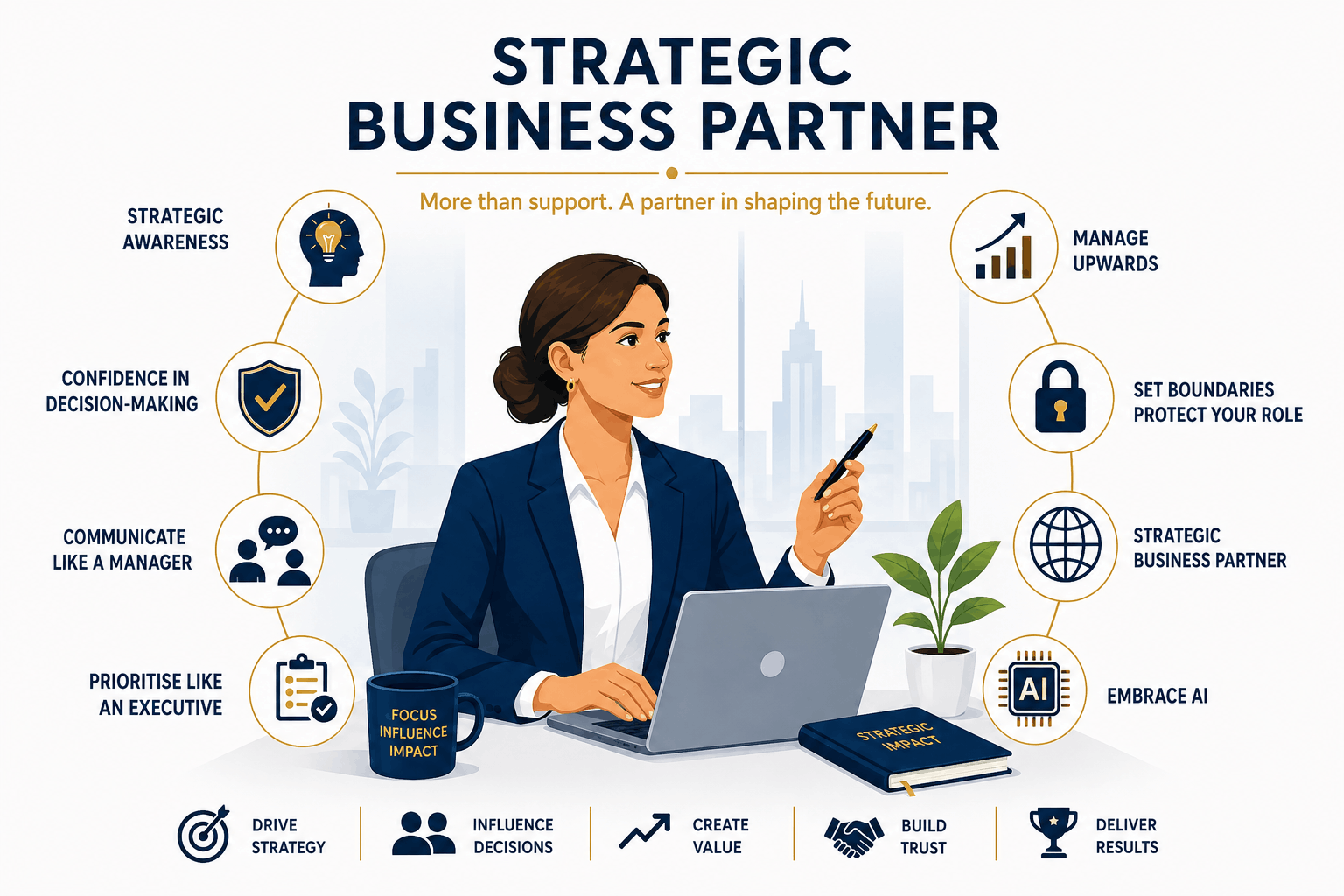
For many years, the traditional role of the executive assistant has been defined by organisation, efficiency and exceptional administrative support. These qualities remain important for an EA, but they no longer define the role. Many EA roles are now more engaged in business support than admin support. This means that the Executive Assistant career has transitioned to being a Strategic Business Partner.
The expectations placed on executive assistants have evolved and bear little relationship with the traditional role. Organisations now need EAs who can think strategically, influence decisions, solve problems and become trusted partners to senior leaders. The modern executive assistant is no longer simply supporting the business. They are now helping to shape it.
The transition from administrator to strategic business partner does not happen because of a job title. It happens because of the way you think, communicate and approach your role every day.
Develop Strategic Awareness
Strategic awareness is the knowledge base needed to become a genuine business partner. This awareness of strategic-level priorities means that you will start considering the wider impact of every decision. It means that strategic business partners will ask whether a request supports the organisation’s priorities, creates value and is the best use of time and resources.
Executive Assistants who understand the bigger picture are able to anticipate challenges before they arise and head off issues before they happen. They recognise opportunities that others may overlook and can help executives focus their attention where it matters most. The greater awareness enables your executive to delegate more higher-level decisions and problem-solving to a strategic Executive Assistant.
Build Confidence in Your Own Decision-making
Confidence is one of the most valuable qualities an executive assistant can develop, and confidence comes from knowledge. The greater your high-level knowledge, the more you will be assertive in delivering your role. EAs work closely with senior leaders every day and understand their competing priorities, organisational pressures and the practical realities of delivering results. Additionally, you are a bridge between the team and management, which means that you can read the room better from this perspective than management in certain situations.
Being confident does not mean believing you are always right. It means trusting your judgement, sharing your opinions professionally, and feeling comfortable making recommendations when appropriate. Executives now expect their assistants to contribute ideas and are not looking for an assistant who is waiting for instructions. This is a defining difference between more senior EAs and more junior PAs.
Communicate Like a Manager
Senior leaders need to be able to communicate their ideas and instructions with clarity and purpose. Their mindset often will focus on outcomes rather than activities. Executive Assistants need to communicate in the same way to naturally build greater credibility. However, they can also translate the high-level messaging of their executive to more user-friendly operational messages for a wide audience.
A good communicator will keep updates concise, focus on the key message and present possible solutions rather than simply describing problems. This is the quality of good managerial communications. Executive Assistants who communicate effectively will be able to influence how others perceive their contribution. This raises your personal branding at work.
Prioritise Like an Executive
One of the greatest skills an Executive Assistant can develop is the ability to prioritise work in the same way as the executive they support. The ability to prioritise like your manager means that you will be able to synchronise with your executive. However, this is only possible with commercial and strategic awareness.
Successful executive assistants constantly assess which activities will have the greatest impact on business objectives. They protect executive time, question unnecessary meetings, and make informed decisions about where effort should be directed. Strong prioritisation confirms that you have the strategic awareness of a strategic business partner.
Learn to Manage Upwards
Managing upwards is an essential leadership skill for every Executive Assistant. Managing upwards can include saying no, which can be challenging. However, it could also mean challenging priorities, questioning requests, or encouraging your executive to reconsider how they are spending their time. This requires assertiveness, diplomacy and mutual trust. Mutual trust can be in your trustworthiness, but more often than not in your abilities. If you have a partnership mindset with regard to your executive, it is a great asset. Remember that the strongest partnerships are built on honest conversations and professional respect.
Set Boundaries and Protect Your Role
Strategic executive assistants who say yes to every request often have less time for the work that delivers the greatest value. Setting boundaries allows you to focus on higher-level responsibilities while encouraging others to take ownership of work that sits within their own roles. Defending your role is not about refusing to help. It is about ensuring your skills are used where they make the biggest difference.
Strategic Business Partner
Outstanding executive assistants understand the business, its objectives, its challenges and the environment in which it operates. They know what matters to senior leaders and understand how different departments contribute to organisational success. This wider perspective enables them to make better decisions and provide support that extends well beyond administration. Strategic awareness grows through curiosity, continuous learning and genuine interest in the organisation.
Embrace AI
AI is changing the way Executive Assistants work. Routine administrative tasks such as drafting documents, summarising meetings, conducting research, organising information and producing first drafts can now be completed much more efficiently. AI creates valuable time to focus on activities that require human judgement, relationship building, strategic thinking and problem solving.
The most successful executive assistants will not be those who compete with artificial intelligence. They will be those who use it intelligently to increase their impact and strengthen their partnership with senior leaders. Technology should create more opportunities for strategic work by automating administrative tasks that take up your valuable time.
The Future Belongs to Strategic Executive Assistants
Executive Assistants who stand out are those who think strategically, communicate with confidence, manage upwards effectively, prioritise with commercial awareness, set healthy boundaries and understand the organisation’s wider goals. Additionally, they will boast leadership qualities.
When these qualities are combined with strong business knowledge and the intelligent use of artificial intelligence, Executive Assistants can move beyond administration and become genuine strategic business partners. That is where the future of the profession lies. We offer an Executive Assistant Diploma to the C-Level for those interested in pursuing senior EA careers.